Stunning Tips About What Happens If You Reverse The U And V Phase Wires

Automatic Phase Reverse Protection Circuit
What Happens if You Reverse the U and V Phase Wires
You're standing in front of a panel, maybe after a long night of troubleshooting or a rushed rewire. You swap two wires, tighten the lugs, and fire up the motor. It hums. It runs. But does it run in the right direction? Honestly? Reversing the U and V phase wires is one of those mistakes that sounds like a minor brain fart, yet it can turn your entire day into a circus of spinning parts and fried logic. Let me walk you through exactly what happens when you make that swap, and I'll tell you the parts that the textbooks gloss over. Because this isn't just about "motors running backwards." It's about transformers humming wrong, generators shitting themselves, and control systems that suddenly think the world is upside down.
The Quick Reality Check: What You're Actually Changing
Before we dive into the carnage, you need to understand the fundamental thing you've just tampered with: phase sequence. In a three-phase system, we label the phases A, B, C (or U, V, W depending on your region and standard). The order in which those voltages peak matters. Think of it like a conga line—if U leads V by 120 degrees, and V leads W by another 120, the whole dance is smooth. Reverse the U and V phase wires, and you've effectively told V to lead U instead. The conga line now stumbles. The motor doesn't know why, but it will react by rotating the opposite direction. That's the simple version. But the real story is messier.
Look—this swap is so common that I'd estimate nearly every field electrician has done it at least once. It happens during panel upgrades, when you're tagging wires at 2 AM, or when a junior tech decides to "fix" a loose connection and just grabs the first two cables. The consequence depends entirely on what you're feeding. If it's a simple pump motor, you just swap two leads at the motor and move on. If it's a complex HVAC system or a CNC machine, you might be looking at a few hours of head-scratching and component replacement.
Seriously, the phase reversal condition is not a "maybe it works" scenario. It is a binary outcome: either the load is designed to handle it (rare), or it isn't (common). The equipment doesn't negotiate. It just responds to the magnetic field direction. And when you swap the phase wires, you flip the rotating magnetic field vector by 180 degrees. For a motor, that means the rotor now chases a phantom. For a transformer, it means the flux path gets confused. For a generator, it means you are about to create a literal explosion of copper and steel.
Let me give you a real-world aside. I once watched a senior engineer reverse U and V on a 500 HP chiller compressor because the wire labels had worn off. The compressor ran backwards for about four seconds. The oil pump stopped working, the bearings starved, and the shaft seized. It cost the company $12,000 in repair and a week of downtime. All because nobody used a rotation meter first. Don't be that guy.
The Big Impact: What Happens to Your Equipment When You Reverse the U and V Phase Wires
Three-Phase Motors: The Most Common Victim

One Of The Best Info About What Is U And V In Wiring Blog | Adem Energy
This is the classic scenario. You reverse the U and V phase wires feeding a three-phase induction motor, and the motor will immediately try to run in the opposite direction. That's the headline. But the subheadline is worse: not all motors handle this gracefully. Some motors, especially those with integrated fans, pumps, or compressors, have a specific rotation direction for a reason. If the fan blade is designed to push air one way, running it backwards actually reduces airflow by about 60%. The motor draws more current because it's fighting the aerodynamic load, and it overheats. You can smell the varnish burning within minutes.
Then you have positive displacement pumps. Run a gear pump backwards, and it might still move fluid, but the internal check valves will slam shut. You'll blow a seal or crack the housing. I've seen a hydraulic pump that looked like a grenade went off inside because someone reversed U and V and the pressure relief valve couldn't handle the reversed flow. It's not a pretty sight. The point is: a motor running backwards isn't just a directional inconvenience. It's a thermal and mechanical time bomb.
Interestingly, some motors don't care at all. If you have a general-purpose fan that moves air symmetrically, or a conveyor belt that needs to run both ways, reversing U and V is just a control command. You can literally swap the wires on the fly (don't do that while it's running, that's stupid) and the motor will just comply. So the first question you should ask is not "Did I swap U and V?" but "Does my load care about rotation direction?" Most loads do care. Pumps. Compressors. Machine spindles. Lawnmower blades. Anything with a one-way valve or a directional impeller will suffer.
Another nuance: if the motor is connected to a variable frequency drive (VFD), the story changes completely. A VFD controls the phase sequence internally. If you reverse U and V on the input side of the VFD, the drive might just laugh at you. It rectifies AC to DC, so the input phase order is irrelevant. But if you reverse U and V on the output side of the VFD (between the drive and the motor), you've just reversed the rotation command. That's it. The VFD handles it. But here's the kicker: some older drives have protection circuits that will trip if they detect a phase reversal on the input. They're looking for a specific sequence to power their internal logic. So you could swap U and V, and the drive never powers up. That's a fun 20 minutes of troubleshooting.
Transformers and Other Passive Loads (The Quiet Ones)
People think transformers don't care about phase sequence. They're passive devices. Iron cores. Copper windings. Voltages just transform. That's mostly true for a simple step-down transformer feeding a generic resistive load. But the moment you involve a transformer bank wired for a specific vector group, you've walked into a trap. For example, a Delta-Wye transformer bank relies on the phase sequence to produce the correct phase shift between primary and secondary. If you reverse the U and V phase wires on the primary side of a Delta-Wye transformer, the secondary voltage phase angles rotate. You end up with a 30-degree shift instead of the expected -30-degree shift, or vice versa.
This is a huge deal when you have multiple transformers feeding a common bus or a parallel power system. If two transformers are supposed to be in parallel, and one has a reversed phase sequence due to a swapped U and V, you will create a circulating current that can be six times the rated full-load current. It literally becomes a short circuit between the two transformers. The protective relays should trip, sure, but sometimes they don't fast enough. You get a cascade of failure. I've seen a whole substation trip off because a technician accidentally swapped the phase wires on a utility tie transformer during a maintenance window. The lights went out for 40,000 people. Not my finest hour, but it wasn't me.
Then there are harmonic filters and power factor correction capacitors. These are also passive, but they are tuned circuits. If you reverse U and V feeding a three-phase capacitor bank, nothing really happens to the capacitors themselves. They still do their job. But any control system that monitors the phase sequence for the capacitor switching logic will go haywire. The controller expects phase A to lead phase B. If it sees phase B leading, it might refuse to close the contactor. Or worse, it closes the contactor at the wrong time, causing a transient current spike that damages the capacitors internally.
Honestly, the passive loads are the sneaky ones. You swap U and V, everything seems fine for weeks. Then a site-wide power dip happens, and the system collapses because the phase-sensitive relaying was actually fighting itself the whole time. It's a slow-motion disaster. Always verify your transformer connections with a rotation test on the secondary side after any maintenance. It takes two seconds with a handheld phase rotation meter.

3 Phase Motor Wiring Diagram U V W
The Danger Zone: Generators and Control Systems
Generators: The Backward Spinning Bomb
If you reverse the U and V phase wires on a generator that is feeding a load, you're asking for trouble. But the real horror show is when you incorrectly connect a generator to a live utility bus. Imagine this: you're bringing a backup generator online during a power outage. You carefully match the voltage and frequency. You close the breaker. And because someone earlier reversed U and V on the generator output leads, the phases are now 180 degrees out of sync with the utility. The result is a massive instantaneous current. We're talking tens of thousands of amps. The generator shaft twists. The stator windings become vaporized copper. The breaker might explode. I've seen the aftermath of a generator synchronization gone wrong due to a phase reversal, and it looks like someone detonated a small bomb inside the enclosure.
Even if you're not paralleling with the grid, running a generator with reversed phase wires feeding a single load can cause issues. The generator's automatic voltage regulator (AVR) often samples the output voltage from one phase to ground. If the phase sequence is swapped, some AVR designs get confused and regulate the wrong phase. You end up with unbalanced voltages. The generator runs rough, the engine governor hunts, and you might get a flickering output that damages sensitive electronics. Don't do it.
There is a small exception. Some portable generators are inherently "free-rotating" in the sense that the engine doesn't care about rotation direction. But the alternator's rotating field still matters. If you physically spin the rotor in the opposite direction (by swapping the phase wires on the exciter or by reversing the prime mover direction—which is absurd), the output sequence flips. But in practice, you never reverse a generator's phase wires intentionally. It's a critical safety violation.
Here's the rule I use: if you touch any generator output cable, you use a phase rotation meter before closing any breaker. Full stop. I don't care if you're just testing with a lamp load. The cost of the meter is $150. The cost of a wrecked generator is $50,000. Do the math.
Control Circuits and Protective Relays (The Confused Logic)
Modern industrial control systems are picky eaters. Many PLCs, motor protection relays, and power monitors check the phase sequence as a standard operating condition. If you reverse U and V feeding the control panel, the relay might see the wrong rotation and refuse to close its contactor. That's actually a safety feature. But what if the relay is programmed to show a "Phase Failure" alarm even though all three phases are present? You'll waste hours looking for a blown fuse when the issue is just a swapped wire at the main disconnect. I've spent an afternoon chasing a ghost alarm because some apprentice swapped U and V at the meter base.
Then there are energy meters. Utility-grade meters that measure kWh, kVARh, and power factor rely on knowing the correct phase sequence. If you reverse U and V, the meter will still give you a number, but that number is garbage. It will register reverse power flow, negative vars, or completely wrong totals. You could end up billing a customer for power they didn't consume, or worse, you might think your facility is saving energy when it's actually wasting it. That kind of data error stays hidden for months until someone does a sanity check with a handheld meter.
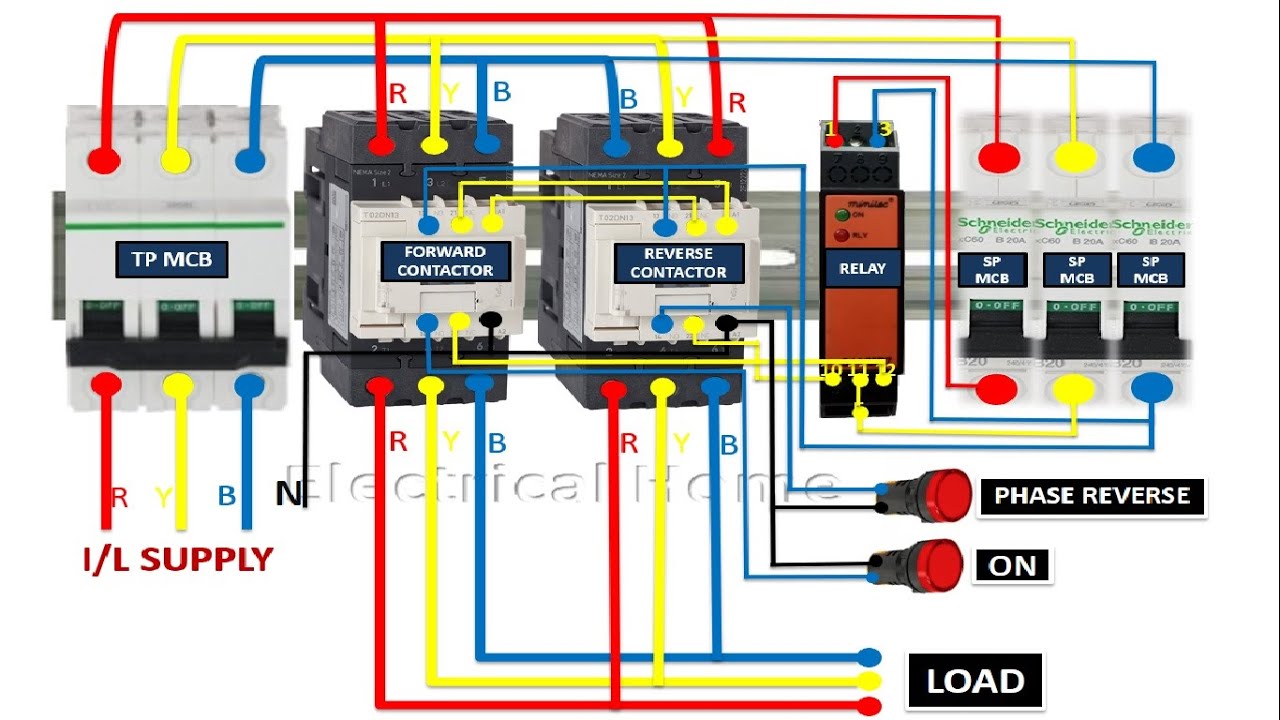
What Is Reverse Phase Sequence Relay at Jesse Jonsson blog
Variable speed drives and soft starters also have phase detection. Some drives will not start if the input phase wires are reversed. They display an error code like "PHASE LOSS" or "INPUT FAULT". That drives technicians crazy because the phases are clearly present. But the drive is just designed to require ABC rotation. Swap U and V, and it thinks phase A is missing. The solution is either to swap two input wires at the drive terminals or to change a parameter that disables phase sequence checking. But most technicians don't know that parameter exists. So they call me, and I ask them to bring out their rotation meter.
One more thing: uninterruptible power supplies (UPS). A UPS typically has a bypass circuit that matches the input phase sequence. If you reverse U and V on the input to a double-conversion UPS, the rectifier stage might not care, but the static bypass switch absolutely cares. If the UPS needs to transfer to bypass during a failure, and the bypass line has the wrong sequence, the transfer may fail or cause a momentary interruption. Hospital equipment hates that. When I worked at a data center, we had a strict rule: after any maintenance, we verified the phase rotation on both the main feed and the bypass feed before putting the UPS back online.
How to Spot a Phase Reversal (Without Blowing Anything Up)
The Simple Motor Test
If you already have a motor connected and you want to know if someone reversed U and V, the absolute fastest method is to just bump the motor. Briefly energize it for half a second and watch the shaft direction. Compare that to your expected direction. If it spins the wrong way, you've got a reversal. But hold on—don't rely on this for critical loads. Bumping a compressor that has zero oil pressure can cause damage even in half a second. Use a phase rotation meter instead. It's a passive test with no moving parts.
Another trick: if you have a portable fan or a small induction motor that you know the rotation of, you can temporarily connect it to the same source. Let it spin up, mark the direction, then swap U and V and do it again. This is a low-voltage test that doesn't risk big equipment. I keep a "rotation test motor" in my truck for this exact reason. It's a beat-up 1/4 HP motor with a piece of tape on the shaft. It has saved me countless times.
But honestly, the motor test is old-school. Modern tools are better.
Using a Phase Rotation Meter (The Only Tool You Need)
A phase rotation meter is a handheld device with three leads. Clip them to U, V, and W (or L1, L2, L3). The meter will show either "ABC" (clockwise) or "CBA" (counter-clockwise). If you expect ABC and the meter reads CBA, you have a phase reversal condition. That's it. No guesswork. No bumping motors. This is the definitive answer. I own three of these meters. One stays in my main tool bag. One is in my truck. One is in my office just so I never have an excuse.
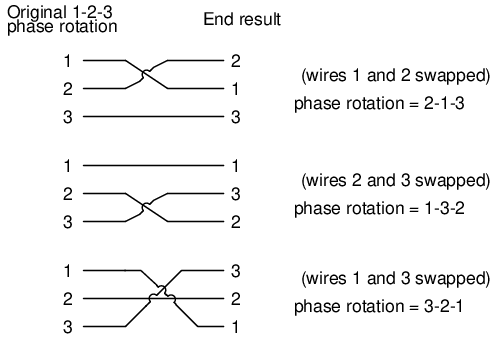
Lessons In Electric Circuits -- Volume II (AC) - Chapter 10
Here is a quick safety list for using them:
- Never connect the meter to live high-voltage terminals without proper PPE. It is a test instrument, not a magic wand.
- Always test the meter on a known-good source first to confirm it's working.
- If the meter reads "O/C" or "Open," don't trust it. Check your lead connections.
- Some meters have a "Phase Loss" indicator. If you see that, fix the missing phase before worrying about rotation.
The beauty of the rotation meter is that you can test at any point in the circuit. You can test at the main breaker, at a subpanel, at a motor disconnect, or at a terminal block. If the reading is consistent throughout the circuit, then the phase wires are all correct downstream. If you get ABC at the main and CBA at the motor, you know the problem is between those two points. That's a powerful diagnostic capability.
Now, a common question: can you reverse U and V at the motor terminals to "correct" the rotation? Yes, absolutely. That is the standard fix. If the rotation is wrong, swap any two phase wires at the motor junction box. It doesn't matter which two. U and V, V and W, or U and W—any swap will reverse the direction. Just make sure the motor is disconnected and locked out before you touch the wires. This is basic electrical safety, but you'd be surprised how many people "just flip the switch quickly." Don't.

What is U,V,W? (for AC motors)
Common Questions About Reversing U and V Phase Wires
Will reversing U and V damage a motor immediately?
Not always. A motor can run backwards indefinitely if the load allows it. But if the load is a pump or compressor that requires correct rotation, damage can occur within seconds due to lack of lubrication or blocked flow. For a fan with symmetrical blades, it can run backwards for hours without issue. The real damage comes from the load, not the motor itself.
Can I reverse U and V on a running motor?
You absolutely should not do this while the motor is under load. It's called “plugging†and it puts extreme mechanical stress on the shaft and couplings, plus it creates a massive current surge. However, on small fractional-horsepower motors, technicians sometimes do it to stop the motor quickly. But for industrial motors, this is a bad practice. Always stop the motor, lock it out, then swap the wires.
Does reversing U and V affect the voltage level?
No. The voltage magnitude between any two phases remains the same. Only the sequence changes. So your voltmeter will show the same 208V or 480V regardless of which wire is U or V. You cannot detect a phase reversal with a voltmeter alone. You need a rotation meter or a test motor.
What happens if I reverse U and V on a three-phase heater?
A pure resistive heater, like a strip heater or an immersion heater, does not care about phase sequence at all. The heater will operate normally. The current flow is the same regardless of which phase leads. So for heaters, reversing U and V is harmless. That's one of the few loads where it truly doesn't matter.
Is there a color code that prevents this mistake?
Standard color codes exist (Brown, Black, Grey for 120/208V, or Brown, Orange, Yellow for 277/480V in the US), but they are often ignored in the field due to old wiring, different standards, or lazy labeling. Never trust color alone. Always verify with a phase rotation meter before energizing critical equipment. Trust me on this one.

Post a Comment for "Stunning Tips About What Happens If You Reverse The U And V Phase Wires"
Post a Comment